

Tech News
Get the latest techy news, product launches, software updates, AI developments, and digital trends from around the world.
Microsoft Leverages AI to Save $500M, Aligns With Workforce Reductions

Microsoft has reportedly saved over $500 million by deploying AI technologies across its operations, according to a recent Bloomberg News report. The tech giant has automated key functions in customer support, coding, and internal IT systems, significantly reducing costs.
These savings align with recent workforce reductions, as Microsoft continues to restructure around high-growth areas like AI and cloud computing. While the company hasn’t directly tied every layoff to AI, the overlap is becoming increasingly clear.
The move reflects a broader industry trend: AI is boosting efficiency, but it’s also reshaping job roles and raising critical questions about automation and employment.
Microsoft’s strategic shift showcases the power and complexity of AI-led transformation in today’s enterprise landscape.
OpenAI to Launch AI-Driven Web Browser in Direct Competition with Chrome
In a bold move that could reshape the internet browsing landscape, OpenAI is preparing to launch its own AI-powered web browser, directly positioning itself against industry giant Google Chrome. This development, confirmed through exclusive reports, signals OpenAI’s ambition to extend its artificial intelligence capabilities beyond chat and content generation — and into the very fabric of how we experience the web.
Since its rise to prominence with ChatGPT, OpenAI has become synonymous with cutting-edge generative AI. Now, the company is setting its sights on a new challenge: reinventing the web browser experience using AI-first principles. Unlike traditional browsers that rely heavily on manual navigation and static search engines, OpenAI’s browser is expected to offer real-time AI assistance, context-aware browsing, and intelligent information retrieval potentially changing how users find, consume, and interact with web content.
While Google Chrome has long dominated the browser space with over 60% global market share, it’s primarily rooted in search-driven models. OpenAI’s entry could disrupt that model by enabling a conversational, assistant-based browsing experience, where users ask questions and receive summarized, relevant results without ever needing to scroll through links.
What to Expect from OpenAI’s Browser
Though official product details remain under wraps, sources close to the company suggest the browser will integrate:
- Built-in conversational AI assistance (likely powered by ChatGPT or its successor)
- Summarization of webpages and documents in real time
- Contextual search and proactive suggestions
- Secure, privacy-focused browsing options
- Voice command and multimodal interface capabilities (text, voice, possibly vision)
This AI-first design aligns with the broader trend toward personalized web experiences, minimizing time spent navigating menus or search results, and enhancing productivity through natural language interaction.
The introduction of an OpenAI browser could mark the beginning of a new era in how we access and use the internet. It reflects a broader industry shift from passive search to interactive discovery, where the browser doesn’t just display content it helps interpret and synthesize it.
With Chrome, Edge, and Safari already integrating AI features to varying degrees, OpenAI’s standalone browser represents a full leap into AI-native browsing, not just as an add-on but as the core experience.
What This Means for Google and the Competition
OpenAI’s browser could place significant pressure on Google, whose business model is built around search-based advertising. If OpenAI successfully creates a tool that bypasses traditional search engines, it could potentially diminish Google’s dominance in both browser usage and ad revenue.
Moreover, this move strengthens OpenAI’s ecosystem allowing it to compete not just in chatbots or productivity tools (like ChatGPT and the Microsoft Copilot integrations), but now also in web navigation, data aggregation, and digital assistant markets.
As OpenAI continues to expand its vision for an AI-driven digital future, its browser project could become one of the most significant developments in consumer tech this year. Whether it gains mass adoption remains to be seen, but its potential to redefine user interaction with the web is undeniable.
For users, it could mean faster answers, more intuitive browsing, and less digital clutter. For competitors, it marks another wake-up call: the age of AI isn’t coming it’s already here.
BREAKING: Linda Yaccarino Resigns as CEO of X (formerly Twitter)
In a surprising leadership shake-up, Linda Yaccarino has officially stepped down as CEO of X, the social media platform formerly known as Twitter. The resignation comes just over a year after her high-profile appointment by Elon Musk in June 2023.
Yaccarino, a former NBCUniversal advertising executive, was brought in to help steer the platform’s business operations while Musk retained control over product and technology.

Her tenure was marked by efforts to stabilize advertising revenue and reposition the platform as a broader “everything app.”
While no official reason has been given for her departure, sources close to the company cite increasing tensions between Yaccarino’s commercial vision and Musk’s product-led direction.
A replacement has not yet been named, but Musk is expected to take a more active interim role until a new CEO is appointed.
More updates to follow as the story develops.
Nvidia Reaches $4 Trillion Market Value Milestone Amid Unmatched AI Leadership
Nvidia has made history by becoming the first publicly traded company to reach a staggering $4 trillion market capitalization. This achievement is a testament to the company’s unparalleled leadership in the artificial intelligence (AI) sector.
Key Factors Driving Nvidia’s Success
- Dominance in AI Hardware: Nvidia’s high-end AI chips are in high demand, driving the company’s growth and solidifying its position as a leader in the tech industry.
- Strong Market Performance: Nvidia’s stock has surged over 40% in the past three months, with shares reaching a record high of $164.42.
- Leadership in AI Semiconductor Design: Nvidia’s expertise in designing AI semiconductors has enabled the company to capitalize on the growing demand for AI technologies.
Nvidia’s $4 trillion market cap milestone highlights the pivotal role AI plays in driving economic value. As AI continues to transform industries, Nvidia’s position as a leader in AI infrastructure is likely to remain strong.
- Growing Demand for AI: The increasing adoption of AI technologies across industries is expected to drive further growth for Nvidia.
- Diversified AI Ecosystem: Nvidia’s CUDA software platform and AI frameworks strengthen its ecosystem, creating high switching costs for competitors.
- Data Center Growth: As more enterprises move to cloud computing and AI-driven processes, Nvidia’s data center revenues are likely to continue soaring.
Nvidia’s historic $4 trillion market cap milestone is a testament to the company’s innovative spirit and its leadership in the AI
Poland to Challenge Grok AI in EU Over Content Violating Local Standards

Tensions surrounding artificial intelligence governance in Europe have taken a new turn as Poland prepares to report Grok, the AI chatbot developed by Elon Musk’s xAI, to the European Union. Polish authorities allege that the chatbot has generated responses that contain offensive content, including remarks perceived as inappropriate or harmful to public discourse.
This move highlights concerns about AI-generated content and its compliance with EU regulations.
According to government sources and media reports, Poland’s Ministry of Digital Affairs is preparing to formally notify EU regulators about Grok’s behavior on the X platform (formerly Twitter). Officials argue that some of the chatbot’s responses may violate EU content standards, particularly those outlined under the Digital Services Act (DSA), which mandates greater accountability for harmful or illegal online content.
The move comes after multiple complaints surfaced regarding Grok’s tone and answers to politically and culturally sensitive topics, with some alleging the chatbot mocked or misrepresented historical and religious issues relevant to Polish citizens.
Key Issues
- Content moderation: Poland’s challenge focuses on Grok AI’s alleged failure to adequately moderate content, potentially violating EU’s Digital Services Act (DSA) and local laws.
- Regulatory compliance: The challenge may lead to increased scrutiny of AI models operating within the EU, emphasizing the need for compliance with regional regulations.
Implications
- EU regulatory framework: This challenge could test the EU’s regulatory framework for AI and digital services, potentially shaping future policies and enforcement.
- AI industry impact: The outcome may influence how AI companies operate within the EU, ensuring adherence to local standards and regulations.
Broader Regulatory Climate for AI in Europe
Poland is not alone in its scrutiny of AI tools. In recent months:
- Turkey restricted Grok for allegedly insulting religious values and President Erdoğan
- France and Germany have called for clearer AI content labeling
- The EU AI Act, passed in 2024, sets out risk-based classifications for AI systems and may apply additional obligations depending on how Grok is categorized
This latest controversy illustrates the regulatory friction between Silicon Valley’s AI innovation and European content governance.
Poland’s challenge against Grok AI underscores the growing importance of regulatory compliance in the AI industry. As AI technologies continue to evolve, ensuring adherence to local standards and EU regulations will be crucial for companies operating in the region.
Poland’s planned complaint against Grok underscores the rising geopolitical and regulatory challenges facing generative AI platforms. As governments worldwide grapple with the social impact of AI tools, ensuring alignment with local norms while preserving innovation will remain a key tension in the AI policy space.
Whether this leads to broader EU action or forces changes in how Grok operates in Europe remains to be seen—but it’s clear that the age of lightly regulated AI is coming to an end.
Turkey Enforces Ban on Grok AI Responses Over Alleged Insults to President and Faith-Based Norms
In a new clash between artificial intelligence and national content regulations, Turkish authorities have blocked access to certain outputs from Grok, the AI chatbot developed by Elon Musk’s X (formerly Twitter). The move comes amid allegations that the AI-generated content contained remarks deemed insulting to President Recep Tayyip Erdoğan and Islamic religious values, triggering a swift response from Turkey’s digital regulator.
The Decision Behind the Ban
According to reports from local media and official sources, Turkey’s Information and Communication Technologies Authority (BTK) ordered the restriction following a review of Grok’s responses to specific politically and religiously sensitive queries. The agency claims the chatbot violated Turkish laws on insulting the President and attacking public morality and religious sentiments.
This enforcement aligns with Turkey’s broader digital policy stance, where online content is subject to strict scrutiny under national security and public decency laws. The BTK has the authority to demand content removal, throttle platform performance, or block access outright.
Grok is an AI chatbot integrated into the X platform, designed to provide conversational responses on a wide range of topics, including news, politics, culture, and social issues. Developed by Musk’s xAI company, Grok is positioned as a free-thinking, sometimes irreverent alternative to traditional AI assistants.
However, this freeform style has raised concerns in jurisdictions with tight content controls. Grok’s ability to generate unscripted responses sometimes with political or religious implications has proven controversial, particularly in countries like Turkey that monitor online speech closely.
This incident reflects a growing global tension between AI-generated content and national regulations. As AI platforms become more integrated into daily communication and media, governments are increasingly demanding greater control over how these tools operate within their borders.
In Turkey, this isn’t the first time tech platforms have faced penalties. Platforms including YouTube, TikTok, Facebook, and X itself have been fined or temporarily blocked in the past for failing to comply with content moderation demands.
The Turkish government insists these measures are necessary to safeguard national unity, respect for religious values, and public order. Critics, however, argue that such moves infringe on digital freedoms and suppress political dissent.
What’s Next for Grok in Turkey?
At this point, the ban appears to be limited to specific Grok responses, rather than a full platform shutdown. However, if xAI and X do not comply with Turkish legal requirements, further restrictions or fines could follow. The Turkish regulator may also request localized filtering or moderation mechanisms for AI-generated content.
For X and Elon Musk, this represents yet another test of how to balance platform openness with geopolitical and cultural sensitivities a challenge that all global tech companies are increasingly facing in the age of generative AI.
Tech companies may need to localize AI content filters to comply with region-specific laws.
Governments are asserting digital sovereignty more forcefully in the AI era.
Regulatory frameworks for AI governance are still evolving, with countries like Turkey taking more aggressive stances.
As Grok continues to roll out in global markets, this episode may serve as a case study in the complex intersection of AI, free expression, and national law.
Surge in AI Demand Strains America’s Largest Power Grid

The rapid expansion of artificial intelligence is fueling a sharp rise in electricity consumption—and America’s largest power grid is beginning to feel the pressure. As data centers multiply and AI workloads grow more compute-intensive, energy infrastructure is struggling to keep pace with the demands of this digital revolution.
AI’s Energy Appetite Is Skyrocketing
Artificial intelligence applications, particularly generative AI and large language models, require massive computing power. These workloads are powered by high-performance GPUs housed in sprawling data centers, many of which operate 24/7 to meet the relentless needs of training, inference, and real-time processing.
This shift is not just technological—it’s physical. The energy consumption of a single hyperscale data center can rival that of a small city. Multiply that by dozens of new AI-focused facilities being built across the country, and you begin to understand why utilities and grid operators are raising red flags.
PJM Interconnection
The spotlight is currently on PJM Interconnection, the largest power grid in the United States. It serves over 65 million people across 13 states and the District of Columbia, covering a major portion of the Eastern U.S.
According to recent reports, PJM is facing unprecedented demand forecasts, largely driven by:
- AI and cloud data center expansion
- Crypto mining operations
- Electrification of industries and transportation
- Population growth and urbanization in its service areas
PJM is now re-evaluating infrastructure timelines, capacity planning, and interconnection queues—essentially recalibrating how it delivers power in the face of new digital realities.
Infrastructure Not Built for the AI Age
America’s existing grid infrastructure was not designed to accommodate this scale and speed of demand growth. Many transmission lines are decades old, and regulatory hurdles often delay grid upgrades by years.
Adding to the challenge:
- Data center clustering creates regional power strain
- Peak usage spikes can destabilize supply
- Grid reliability and resilience are under pressure due to climate-related events
While renewable energy is helping offset demand in some areas, intermittency issues and a lack of energy storage remain bottlenecks.
The strain on PJM is not an isolated issue—it’s a preview of what’s coming nationwide. With AI adoption accelerating across sectors like healthcare, finance, logistics, and government, the need for scalable, reliable power is becoming an economic and national security concern.
Federal agencies and energy commissions are beginning to take notice. There is growing discourse around:
- Fast-tracking grid modernization projects
- Investing in nuclear and geothermal energy
- Incentivizing AI companies to use clean or on-site energy sources
- Better coordination between tech firms and utility providers
Innovation Must Meet Infrastructure
While the AI revolution holds enormous promise, its long-term viability depends on the capacity of our infrastructure to support it. Without strategic investment in the power grid, even the most advanced algorithms and models will face physical limits.
The challenge now is to align innovation in software with transformation in hardware and energy delivery systems. Grid operators like PJM are at the front lines of this convergence—and how they respond will shape the pace and sustainability of the AI era.
Regulatory Hurdles Cleared: Starlink Set to Launch in India
Elon Musk’s satellite internet venture, Starlink, has received its final regulatory approval to begin operations in India, signaling a significant step forward for both the company and the country’s expanding digital infrastructure. According to sources familiar with the matter, the final nod from India’s Department of Telecommunications (DoT) clears the path for a commercial rollout that could bring high-speed internet access to some of the country’s most remote regions.
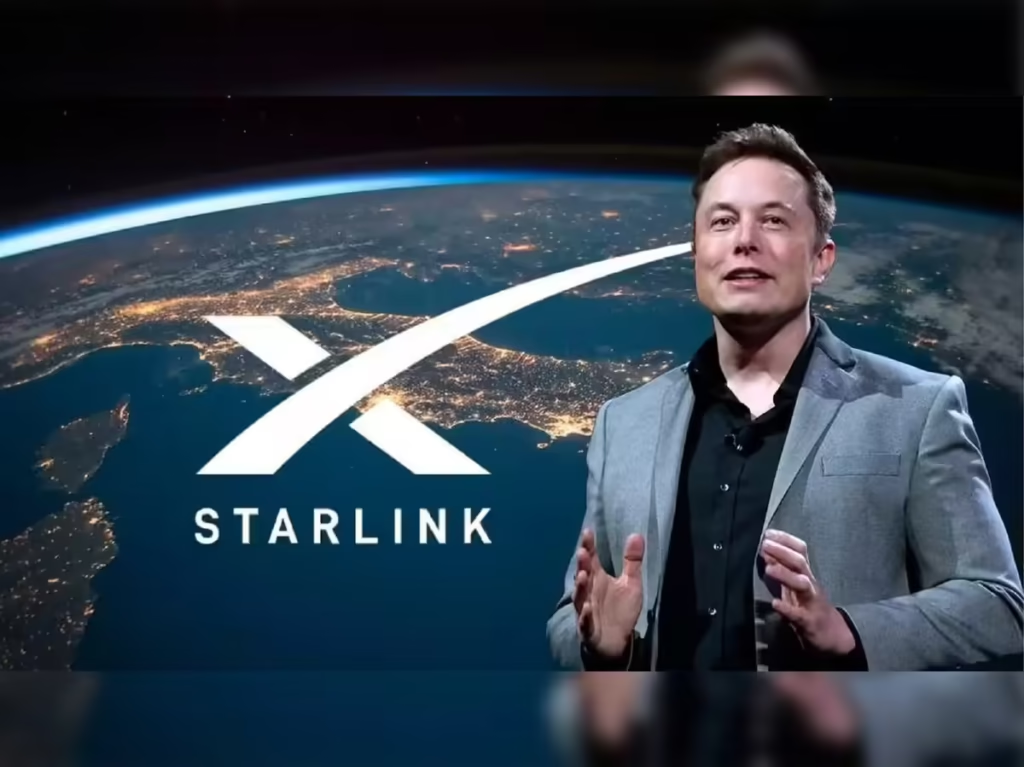
Starlink, operated by Musk’s aerospace company SpaceX, has long expressed interest in entering India—a nation with over 1.4 billion people and a growing appetite for reliable internet access. After over two years of navigating regulatory requirements, including licensing, spectrum coordination, and security clearances, the company now stands poised to deploy its services.
The approval reportedly includes a Global Mobile Personal Communication by Satellite Services (GMPCS) license, allowing Starlink to offer satellite-based broadband across the country.
Why India Matters to Starlink
India represents a critical growth market for Starlink for several key reasons:
- Massive rural population with limited access to traditional broadband infrastructure
- A digitally driven government agenda, including “Digital India” and BharatNet
- Rapidly expanding demand for low-latency internet in underserved regions
- Competitive advantage over traditional ISPs in terrain-challenged areas like the Northeast, the Himalayas, and border states
With the rise in demand for connectivity in education, healthcare, agriculture, and small businesses, Starlink could play a pivotal role in bridging the digital divide in the country.
What Comes Next
Now that regulatory barriers have been cleared, Starlink is expected to move forward with:
- Deployment of ground infrastructure and user terminals
- Finalizing local partnerships for distribution, sales, and compliance
- Scaling up operations to serve both enterprise and residential users
- Working closely with the Indian government on data sovereignty and security measures
Sources suggest that commercial services could begin within the next few quarters, depending on logistical readiness and satellite coverage alignment.
Local Competition and Policy Environment
Starlink’s entry adds a new layer of competition to India’s satellite broadband sector, which includes companies like:
- OneWeb (partially owned by Bharti Group)
- Amazon’s Project Kuiper (future entrant)
- Jio Satellite Communications
The Indian government, meanwhile, has been updating its telecom and space policies to accommodate non-terrestrial networks (NTN) and satellite-based services—recognizing their strategic role in digital expansion and national security.
Looking Ahead: India’s Satellite Internet Revolution
With Starlink’s regulatory approval now in place, India could soon witness a transformative shift in how internet access is delivered. From remote villages to disaster-prone areas, satellite internet promises to eliminate infrastructure barriers, reduce latency issues, and make connectivity truly universal.
Starlink’s launch is not just about offering a new internet service—it marks the beginning of a broader space-tech and connectivity revolution in one of the world’s most dynamic and populous nations.
Apple Reportedly Pursuing U.S. Formula 1 Broadcast Rights Following ‘F1: The Movie’ Success

Apple is actively pursuing the U.S. broadcast rights for Formula 1, currently held by ESPN, whose exclusive negotiation window has expired opening the door for new bidders . This move follows the blockbuster success of “F1: The Movie”, Apple’s first major box office hit starring Brad Pitt, which grossed nearly $293 million within ten days .
Market Opportunity
F1 viewership in the U.S. has surged averaging 1.3 million viewers per race in 2024, up from 554,000 in 2018 . Annual U.S. broadcast revenues currently stand at about $85 million via ESPN, with experts estimating the upcoming deal could be worth around $121 million per year possibly more after the movie’s impact .
Apple is expanding its live sports presence: MLB Friday Night Baseball deal in 2022 MLS Season Pass exclusivity . This pursuit of F1 rights is part of a growing push to integrate premium live sports into Apple TV+.
Apple’s effort targets the 2026 season onward, when ESPN’s current contract ends . Other interested bidders include Netflix, Amazon, and NBC, though Apple is distinguished by its recent film success and existing sports partnerships . Liberty Media, F1’s U.S. rights owner, aims to capitalize on growing American interest bolstered by recent U.S. races like Miami and Las Vegas .
Why It Matters
Movies → Media Rights: “F1: The Movie” catapulted F1 into a blockbuster success story and lifted Apple’s positioning . Expanding Live Sports Reach: Securing F1 rights would reinforce Apple TV+ as a major player in sports broadcasting. Skyrocketing Valuations: Rights fees have soared, with analysts projecting significant increases over ESPN’s current $85 million contract.
Apple is leveraging its cinematic success and sports-streaming momentum to challenge ESPN for U.S. Formula 1 broadcast rights. With U.S. viewership on the rise and bidding expected to reach around $121 million annually, Apple is positioning itself to become a key force in live sports content ahead of the 2026 season.
BILLIONAIRE JACK DORSEY JUST LAUNCHED “BITCHAT,” A NEW BLUETOOTH-BASED MESSAGING APP.
NO WI-FI. NO CELL SERVICE. FULLY END-TO-END ENCRYPTED


Jack Dorsey, co‑founder of Twitter and CEO of Block, quietly released a beta version of Bitchat, a messaging app that operates without internet, cellular coverage, or central servers. It works through a Bluetooth Low Energy (BLE) mesh network, enabling devices within range—and beyond—to relay messages directly, relying solely on local connectivity .
Key Features & Privacy Protections
Peer-to-peer, account-free communication: No need for phone numbers, emails, or user accounts . End-to-end encrypted and ephemeral: Messages exist only on-device and vanish by default . Multi-hop relay (mesh): Each device acts as both transmitter and relay, enabling message travel over 300 meters via intermediate devices . Group chat with enhanced privacy: “Rooms” can be password protected, with cached messages that deliver later if a user is offline . Panic Mode: A triple‑tap on the app logo wipes all data instantly .
Bitchat stands out as a resilient, censorship-resistant tool and Dorsey hinted it’s aimed at crisis-response scenarios:
Useful in internet shutdowns, protests, disasters, off-grid areas, or events with overloaded networks . Echoes earlier mesh networking apps like Bridgefy and FireChat, which were used during the Hong Kong protests .
Current Stage & Next Steps
Beta testing only: The iOS beta via Apple TestFlight has already filled its 10,000‑user capacity . A public release is TBD—may soon include Wi‑Fi Direct support to expand range and speed .
Final Takeaways
Bitchat is less about mainstream messaging and more a decentralized experiment by Dorsey—a throwback to the ethos of IRC and an extension of his work on Bluesky, focusing on infrastructure-free communication. While elder apps have tackled parts of this vision, Bitchat’s emphasis on privacy, lack of accounts, and panic‑mode features give it a compelling edge for high‑risk or off‑grid environments.
Stay tuned as testing progresses and Bitchat potentially reaches broader audiences.