

Artificial Intelligence and the New Era of Human Expertise
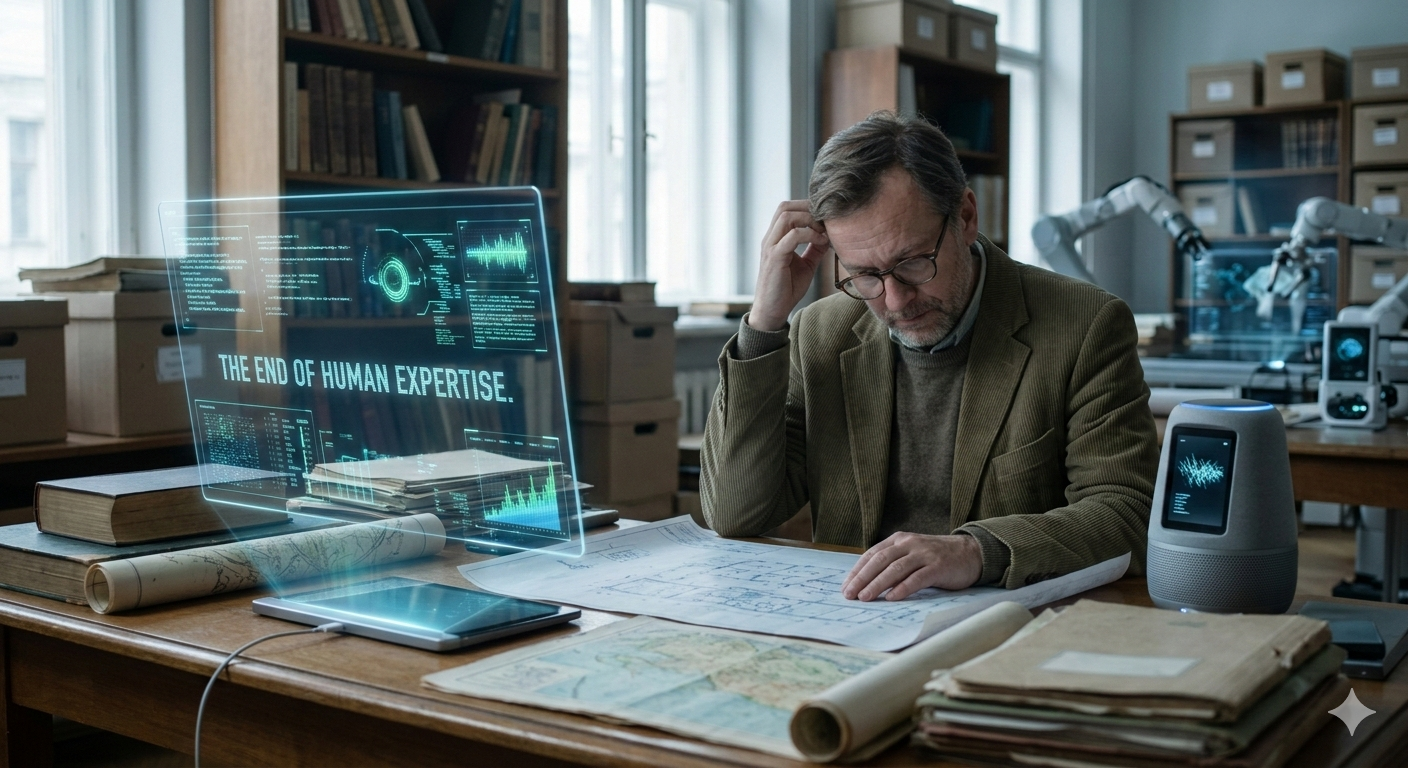
Welcome to the first edition of The Intelligence Shift, a monthly series that explores how artificial intelligence is transforming the meaning of expertise, authority, and knowledge.
In this opening article, we examine the rapid rise of synthetic intelligence, the gradual decline of traditional authority, and the emerging human abilities that will matter most in an age where machines produce answers and people interpret meaning.
For centuries, human expertise fueled progress. Society relied on doctors to diagnose illness, lawyers to interpret laws, teachers to guide learning, and engineers to design infrastructure. Expertise represented far more than technical skill—it formed a social contract. People believed knowledge lived inside individuals who earned it through years of education, discipline, and real-world experience.
However, a profound shift has begun.
Artificial intelligence now changes not only how we access information but also how we define knowledge itself. When a machine can summarize textbooks, construct legal arguments, or generate business strategies within seconds, an unavoidable question emerges:

What does it mean to be an expert in a world where intelligence no longer belongs exclusively to humans?
This transformation does not tell a story of replacement. Instead, it reveals a story of redefinition. Authority, trust, and meaning are shifting beneath our feet.
1. Expertise Once Meant Scarcity; Now It Means Abundance
Throughout most of human history, knowledge remained difficult to access. Several barriers restricted learning:
- geography
- institutional control
- limited literacy
- restricted mentorship
- time-intensive education
Because learning progressed slowly and unevenly, expertise remained rare.
Artificial intelligence has dramatically changed that reality.
Today, a teenager with a smartphone can instantly access:
- medical explanations
- legal frameworks
- coding tutorials
- philosophical discussions
- scientific summaries
- business strategies
As a result, the appearance of expertise now surrounds us—fast, fluent, and confident.
However, this accessibility creates a paradox.
When everyone gains instant answers, the value of simply knowing information decreases.
Modern expertise no longer revolves around possessing facts. Instead, it revolves around interpreting knowledge, placing it in context, and challenging assumptions.
2. The Illusion of Competence With Artificial Intelligence
AI systems communicate with remarkable confidence. They generate structured arguments, polished explanations, and clear reasoning. Rarely do they hesitate unless users explicitly request uncertainty.
Consequently, these systems create a powerful illusion:
Fluency often disguises misunderstanding.
When people read coherent AI responses, they often feel knowledgeable. However, clarity does not equal comprehension.
Consider the education system. Memorization may help students pass exams, yet genuine understanding requires deeper thinking and interpretation.
AI introduces a new cognitive trap:
- People outsource thinking.
- They absorb the generated answer.
- They assume the knowledge belongs to them.
The danger does not lie in AI replacing experts.
The danger lies in convincing non-experts that they possess expertise.
3. The Erosion of Trust
As artificial intelligence performs increasingly complex tasks, people begin to question the value of human expertise.
Today AI systems can:
- write code
- analyze data
- draft reports
- interpret documents
- generate creative ideas
Consequently, traditional authority structures begin to weaken.
Students challenge teachers with AI-generated arguments. Patients arrive with machine-generated diagnoses. Employees question managers because “the model suggested another answer.”
Previously, expertise relied on a simple statement:
“I know this because I studied it.”
Now many people believe:
“I know this because the system confirmed it.”
Yet AI does not function as a neutral authority. Every model reflects the biases, gaps, and assumptions embedded in its training data.
Therefore, when trust shifts entirely from humans to machines, society risks losing something critical—the ability to question the origin of knowledge itself.
4. The New Role of the Expert
If machines generate answers instantly, what role remains for human experts?
Experts should not compete with AI in memorizing information. They should not attempt to produce faster summaries either.
Instead, the expert of the future will become:
- a navigator of uncertainty
- a critic of machine-generated conclusions
- a contextual interpreter of information
- a guardian of nuance
- a translator between human values and machine logic
In other words, the most valuable expert will not know the most facts.
The most valuable expert will understand what knowledge actually means.
This shift marks a major transformation—from expertise as possession to expertise as interpretation.
5. The Rise of Synthetic Knowledge
Another important transformation has already begun.
Artificial intelligence increasingly learns from:
- synthetic datasets
- model-generated text
- machine-produced examples
As a result, AI systems increasingly learn from other AI systems.
This recursive loop creates a new category of knowledge—synthetic, self-referential, and increasingly detached from human experience.
This development raises difficult questions:
- What happens when machines produce the majority of information?
- Who verifies that knowledge?
- How can experts detect errors that spread through automated systems?
- What defines expertise when human observation no longer anchors knowledge?
Society has not yet developed answers to these questions.
Nevertheless, we must begin asking them now.
6. Human Skills That Grow More Valuable
Despite enormous technological progress, artificial intelligence cannot replicate certain forms of expertise.
Not because they require complex algorithms.
Because they require human experience.
These capabilities include:
- judgment
- ethical reasoning
- empathy
- lived experience
- emotionally grounded creativity
- cultural awareness
- the courage to challenge assumptions
AI produces answers.
Humans create meaning.
Therefore, the future will favor people who successfully bridge machine intelligence and human insight.
7. A New Social Contract for Artificial Intelligence Knowledge
Humanity now enters a new relationship with intelligence.
Previously, society followed a simple model:
Experts knew. Everyone else followed.
The emerging model looks very different:
Machines generate information. Humans interpret it.
Consequently, this transformation demands significant adjustments:
- new education systems
- updated professional standards
- stronger ethical frameworks
- better methods for verifying truth
- new expectations for expertise
Human expertise does not disappear.
Instead, it evolves.
The Bottom Line: Expertise Is Transforming
Artificial intelligence has not destroyed expertise.
Instead, it has exposed its true nature.
Expertise never meant:
- memorizing information
- retrieving facts quickly
- generating answers instantly
True expertise involves:
- discernment
- contextual understanding
- interpretation
- wisdom
- the ability to recognize what machines overlook
The age of artificial intelligence does not weaken human intelligence.
Instead, it demands a deeper, more reflective version of it.
We are not witnessing the end of expertise.
We are witnessing the end of old expertise—and the emergence of something far more complex, nuanced, and powerful.
Welcome to The Intelligence Shift.
See Also: Controlling the Connectivity Stack: G+D Reveals New Innovations at MWC
See Also: AI-Iran War Videos Go Viral as Creators Cash In on New Tech
Related Post: China pins hopes on society-wide AI push to add jobs, rejuvenate economy


Related Articles

How to Improve IT Knowledge
Learn why IT knowledge is important today. Discover how technology creates career...


AI-Iran War Videos Go Viral as Creators Cash In on New Tech
The rise of AI-generated Iran war videos has created a new challenge...
How to Set Up Dual Monitors on Windows and Mac
Learn how to set up dual monitors on your Windows PC or...